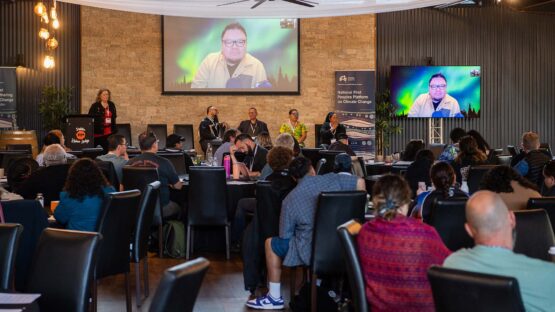
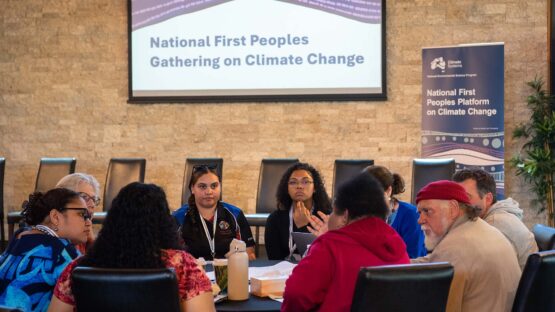
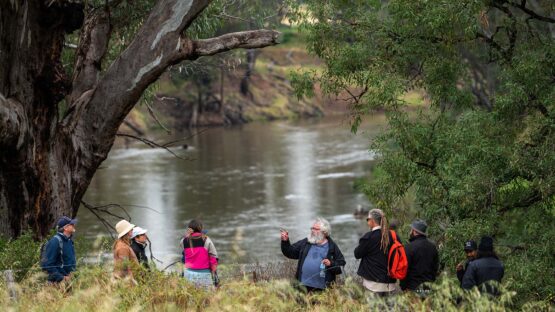
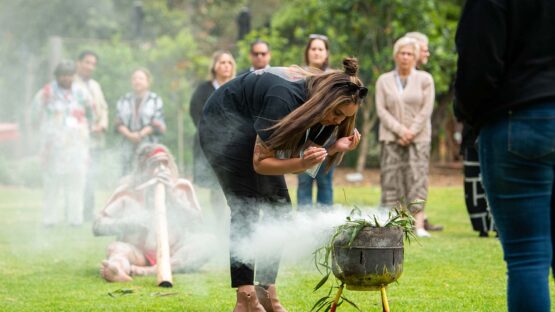
The Gathering is a national event held every two years that brings together First Peoples from across Australia to discuss and share knowledge about responding to climate change. It provides a space for dialogue, collaboration, and cultural exchange, ensuring that First Peoples’ perspectives are central to climate action.
Participants include Indigenous leaders, knowledge holders, community representatives, researchers, and policy-makers, all coming together to share experiences, insights, and strategies for adapting to and mitigating climate impacts.
2024, Tubba-Gah, Dubbo, NSW
On the lands of the Tubba-Gah people of the Wiradjuri Nation, the participants of the National First Peoples Gathering on Climate Change, submit the 2024 First Nations Peoples Statement on Climate Change to the Australian Government.
One of the key outcomes of the Gathering is the development of the First Nation Peoples Statement on Climate Change, which captures the shared priorities, perspectives, and recommendations of First Nation participants. This statement, alongside the statement video, was officially presented to Assistant Minister for Climate Change and Energy, Josh Wilson MP, at the National Adaptation Conference held in July 2025 in Perth.
2021, Gimuy Walubarra Yidinji and Yirraganydji, Cairns, QLD
Gimuy Walubara Yidinji and Yirriganjdji Traditional Owners welcomed the Gathering participants in a wonderful Welcome Ceremony. Field trips led by Gimuy Walubara Yidinji and Yirriganjdji Traditional Owners to the reef, rainforest and beaches allowed talking together with Country. Yarning circles were held back in town, bringing forward many common issues. Building networks and supports between First Peoples and their Countries was a vital theme in discussions about solutions.
2018, Barmah, Victoria
The Yorta Yorta Nation Aboriginal Corporation hosted the National Indigenous Dialogue on Climate Change at the Dharnya Centre, Barmah Forest National Park.
This Dialogue focused on three of the recommendations:
1. Linking communities with scientists who can help them understand climate change and explore its implications.
2. Accessing good information and research and developing the necessary skills within their communities to understand what climate change means for them and determine the best adaptation options.
3. Developing opportunities for knowledge sharing with First Nations communities in Australia and Indigenous people.
2012, Echuca, Victoria
The foundations were laid at the 2012 NCCARF Workshop run by Monash University and the Yorta Yorta Nation Aboriginal Corporation. Following this workshop, the project team met with Damian Morgen-Bulled in Shepparton in 2017, and it was agreed to pursue the National Indigenous Dialogue on Climate Change.