August 28, 2026
Authors: Ramona Dalla Pozza, NESP Climate Systems Hub, University of Tasmania, Jack Johnson, Aurecon, Michael Nolan, Michael Nolan Consulting, Simon Koger, Engineers Australia
Discussions led by the Climate Systems Hub with engineers, hydrologists, and building designers, have highlighted growing concerns that the historical climate information underpinning current design standards may no longer reflect the conditions that buildings and infrastructure will experience during their operational lives. As assets are expected to perform for decades, decisions based solely on historical climate data may increasingly expose communities to damage, disruption, rising costs and safety risks.
This article explores how climate information underpins engineering standards and examines whether some key assumptions used in infrastructure design remain fit for purpose in a changing climate. Through examples relating to extreme heat, rainfall and wind, it highlights emerging evidence that some design thresholds may require review to ensure Australia’s infrastructure remains safe, reliable and resilient into the future.
Australia’s built environment is increasingly exposed to the impacts of extreme weather events, including heatwaves, tropical cyclones, severe storms. Since 2022, severe and catastrophic extreme weather events have caused an estimated $15.4 billion in insured losses and around $28 billion in total economic costs (Insurance Council of Australia). These costs are expected to rise in the future with a changing climate, and likely increases in the frequency and intensity of extreme weather events.
The 2025 National Climate Risk Assessment states that climate risks to Australia’s infrastructure and built environment are expected to increase to high or very high levels by 2050. Infrastructure Victoria similarly estimates that around $60 billion of existing Victorian Government owned or regulated infrastructure could be at risk of damage from extreme weather events by 2030 increasing more than $70 billion by 2070.
Standards, systems and infrastructure are increasingly operating outside their design conditions, undermining their reliability, resilience and long-term effectiveness.
How climate underpins infrastructure standards and why it matters
Standards are voluntary documents that set out specifications, procedures and guidelines that aim to ensure products, services, and systems are safe, consistent, and reliable.
Standards can play a critical role in strengthening the climate resilience of Australia’s built environment by providing a consistent framework for safe, durable, and high-performing buildings and infrastructure. They ensure that design, construction, and material requirements are applied uniformly across regions and asset types, supporting interoperability between systems, stakeholders, and regulatory settings. By establishing clear guidelines for structural performance, material durability, energy efficiency, and hazard resilience, standards help safeguard communities and infrastructure from the growing impacts of extreme weather like heatwaves, flooding, and tropical cyclones.
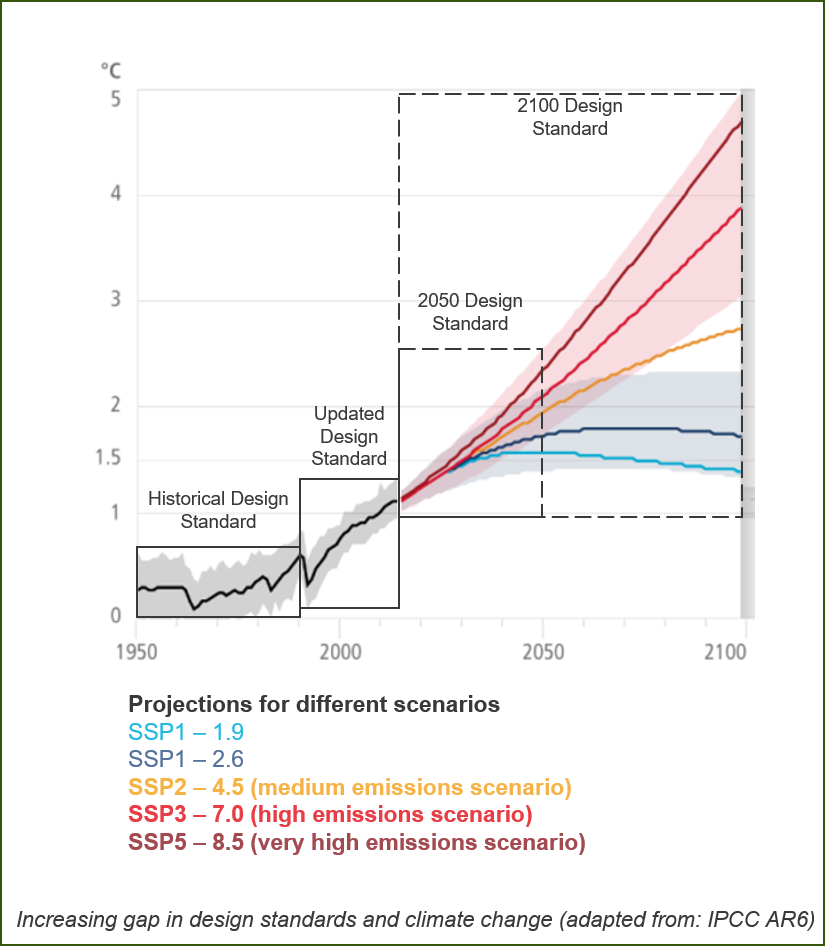
Engineering standards set the minimum requirements for infrastructure design, expected to last for the design-life of the asset, which ranges from 50 years for a residential house up to 100 years for more for critical infrastructure. The need for infrastructure design decisions to be cost-effective and defendable means that engineers are compelled to use the minimum value specified in the standard. Climate-related thresholds have contributed to the setting minimum standards for infrastructure design based on historical climate observations e.g. temperature and wind speed. When the climate was stable as shown for the Historical Design Standard in the figure above, the historical data reasonably predicts the effects in the next 50 years. However, under a changing climate, this assumption no longer holds. Design levels are derived from historical data that look backwards and often include cooler climatic conditions from the past, while the asset will operate in a future characterised by substantially higher temperatures and changing climate extremes. A changing climate therefore represents a fundamental challenge to traditional engineering practice – those statistically derived properties of climatic variables that have assumed to remain constant over time are now demonstrating variability. This non-stationarity implies that infrastructure designed using static historical data may be significantly under-designed for extreme events and the chronic stressors it may encounter over its future operational life.
The examples below highlight design standards and codes of practice developed using historical climate observations. Recent research shows changes in observed trends and projected future extremes, including heat, rainfall and wind. While our confidence in the projections varies (e.g. with high confidence in increasing temperature and rainfall intensity but lower in changes to extreme wind, it is likely that changes to these hazards will impact infrastructure in the future.
The worst-case potential impacts on physical infrastructure play out from combinations of these hazards, referred to as compound events e.g. the combined impact of drought, bushfires and extremes of temperature on energy generation and distribution systems.
Extreme heat
Prolonged heatwaves have significant impacts on people and infrastructure e.g. these events soften and deform road surfaces, buckle rail tracks, cause power outages and equipment failure. Climate-related road and rail incidents cost VicRoads and Public Transport Victoria about $220 million (including insurance claims) from 2004–2020. Summer temperatures routinely force commuter trains to slow down causing delays, with heat thresholds of 36°C in Victoria, and 39 °C in Western Australia.
In January 2009, Melbourne experienced a heatwave with daily maximum temperatures exceeding 43°C for 3 consecutive days, which caused train lines to buckle and led to severe disruption to commuter services. It is clear from observations that Australia, on average, has warmed by about 1.5 °C since national records began in 1910, with most warming occurring since 1950 (CSIRO and BoM, 2024).
Heat extremes have also increased in Australia over the last century (CSIRO and BoM, 2024). In the record warm year of 2019 there were 40 days with extremely high nationally-averaged mean temperatures (those in the warmest 1% of days for each month), about 3 times more extreme heat days than any year prior to 2000. There is high confidence from climate projections that this trend will continue in the future (CSIRO and BoM, 2024).
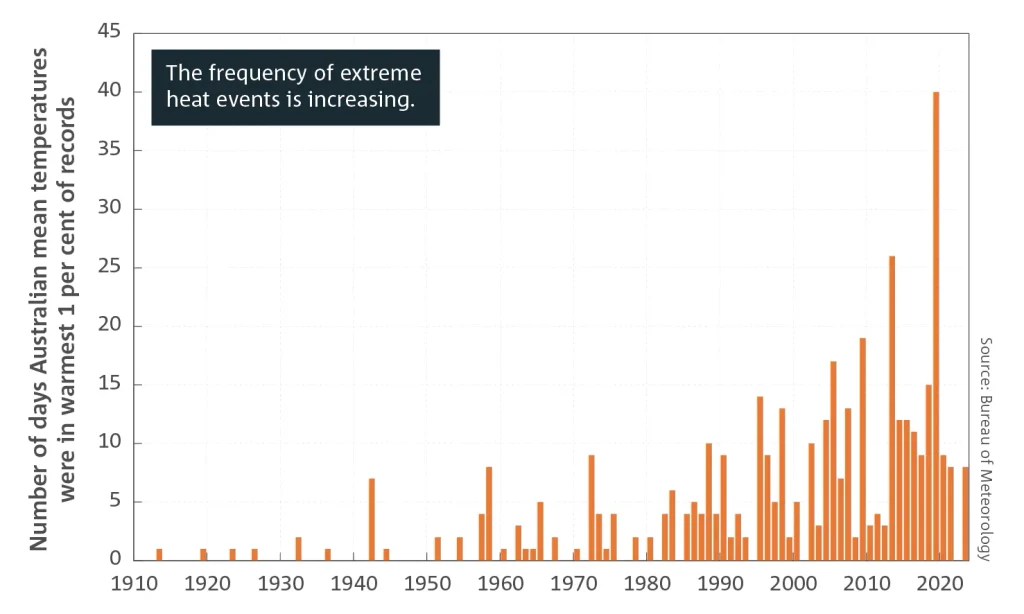
Number of days each year where the Australian area-averaged daily mean temperature for each month is extreme. Extreme days are defined as those where daily mean temperatures are the warmest 1% of days for each month, calculated for the period 1910–2023. Source: (CSIRO and BoM, 2024).
With steel on train tracks already buckling, as Australia continues to experience warmer temperatures in the future, are other metal structures at risk/designed to cope?
Bridges typically have a design life of 100 years. The Australian Standard AS 5100:2017 for Bridge Design defines ambient temperatures for structural analysis based on historical climate data derived past observations Bureau of Meteorology records and does not incorporate future climate change projections.
Design ranges for setting bearings and expansion joints are calculated based on historical seasonal averages maximum and minimum average bridge temperatures. The calculations assume that the ‘normal’ temperature variations of the last few decades will repeat, however it is clear from warming trends in both observations of average and extreme heat events that these temperature thresholds are likely to be exceeded.
Overseas, the 2132m long, steel constructed Tsing Ma Bridge in Hong Kong has 26 years (1999–2024) of field monitoring data. It shows that the annual mean temperature of the bridge deck has increased by 0.28°C per decade and annual extreme temperatures have risen by 0.50°C per decade, with the intensity and the frequency of extreme heat events also increasing.
On a 35°C summer day in 2024, New York City’s Third Avenue Bridge got stuck in the open position for hours because the extreme heat caused the steel joint to expand. This is similar to ‘pavement buckling’ where steel bridges, which are designed to bend slightly under heavy loads, are stiffening as clogged joints prevent them from distributing weight evenly. This additional strain can lead to cracking and, in some cases, structural collapse. So while we haven’t yet seen this happen in Australia – with a clear gap between the design temperature thresholds and the temperatures our bridges are exposed to now and, in the future, it is a risk we need to address.
Extreme rainfall
Extreme rainfall and associated flooding causes damage to roads, rail infrastructure, bridges, and port facilities, disrupting freight movement, supply chains, and emergency response operations. For example, in February 2025, extreme rainfall from a slow-moving tropical low produced more than 1,400 mm of rain north of Townsville, causing major river flooding, road washouts, bridge failures and widespread transport disruption.
Climate scientists expect extreme rainfall events to become more intense in response to global temperature rise, as a warmer atmosphere can hold more water vapour. This has been supported by observations showing, for example, that short duration (e.g. lasting less than hour) rainfall intensities in Sydney have increased by 40% over the last 20 years.
While the Australian Rainfall and Runoff Guideline is not officially a standard, it is a national guideline and is widely used by engineers and the construction industry to manage flood risk for the built environment. Consideration of climate change was included for the first time in the Guidelines released in 2019. The 2024 update to the climate change consideration chapter now includes an 8-14% increase in rainfall intensity (up from a 5% increase in 2019) based on a systematic review of recent research.
Updating rainfall guidelines partly addresses some of the considerations for future flood risk, however there are still gaps in our understanding of short (hourly or shorter) duration rainfall extremes. These events are often tied to intense storms and flash flooding, and have a significant impact on urban infrastructure and the environment. New research through the Climate Systems Hub aims to improve our understanding of these short-duration intense rainfall events and the risk of flash flooding in urban environments, including cities like Sydney.
Changes to rainfall intensity are particularly important in the design of large dams. In Australia, the Australian National Committee on Large Dams (ANCOLD) provides guidelines for assessing rainfall and flood capacity for dams that have a significant risk of damage or loss of life should they fail. A recent study has revealed this risk of failure may have already increased as the world has warmed, with the probability of overtopping more than doubled compared to the historical baseline for four of the dams investigated (Ho et al, 2025).
Extreme wind
Extreme wind events can damage electricity transmission and distribution infrastructure and result in many thousands of customers experiencing power outages. These damaging winds are caused by a range of different weather systems that affect Australia, including tropical cyclones, tornadoes, severe thunderstorms, east coast lows, and strong cold fronts.
Victorians experienced this on 13 February 2024, when extreme winds knocked over six transmission towers in Victoria, causing 500,000 people to lose power, some for more than a week. The weather systems causing these events bring not only extreme winds, but are often associated with extreme rainfall also, causing greater damage as a result of the compound hazards.
Most of the existing transmission network across NSW and Victoria was built during the 1970s. In the 1970s, a transmission tower in inland areas of Australia (outside of cyclonic zones) would have been designed to a wind speed of 45 m/s (162 km/h).
So are these thunderstorms with extreme winds getting worse as the climate changes? It’s possible, but we need to better understand the small-scale processes around thunderstorms, and the way they will change as the climate changes. This makes them harder to study. Similarly, modelling the effects of climate change on extreme wind gusts is an emerging area of research, so it’s hard to say how extreme wind events will change in the future. This doesn’t make it easy when setting design specifications to cope with the future climate.
This is especially true for tropical cyclones. Researchers suggest a likely decrease overall in the number of tropical cyclones due to global warming, however the risk posed by individual tropical cyclones is expected to increase in the future, including as a result of higher sea levels, increased rainfall intensity and higher peak wind speeds, on average.
Wind engineers have recognised an increasing trend in the intensity of tropical cyclones, and have included a ‘climate change multiplier,’ applied in Australian Standard AS./NZS 1170.2. The objective of this Standard is to provide wind strengths for use in the design of structures subject to wind action and the 1.05 multiplier is applied to the gust wind speeds from tropical cyclones to account for expected increases in intensity in the future.
However, there is no such factor to address the southward movement of tropical cyclones, a potential risk supported by global trends and ocean warming trends. Climate Systems Hub researchers are working directly with wind engineers to examine trends in historical tropical cyclone intensity data, to understand the risk of destructive tropical cyclones extending further south.
The work is particularly important because according to Standard AS/NZ1170.2, the heavily populated south-east Queensland and north-east New South Wales regions are currently outside the wind loading zones for tropical cyclones, meaning infrastructure is not built to withstand the winds associated with tropical cyclones. Brisbane residents were recently reminded of this risk, when Tropical Cyclone Alfred loomed off the coast in March 2025.
Even with an estimated AUD $1.7 billion in damage and the most widespread power outage in Queensland’s history, experts from the James Cook University Cyclone Testing Centre concluded the region “dodged a bullet” – had Tropical Cyclone Alfred maintained its forecast winds (140–155 km/h), widespread structural damage and even higher levels of water damage were likely (Boughton et al., 2025).
What is needed under a changing climate
In the face of this growing body of evidence that our climate is changing, and our building standards are not keeping pace, but need to be ahead of climate change to ensure that assets are designed for likely events within their lifetime (the next 50 to 100 years). We need a targeted review of key Australian building and infrastructure standards to determine their suitability under future climate conditions. Establishing the rationale and need for integrating climate considerations into future standards updates and identifying the key priority areas for action is urgently required.
There are significant financial opportunities in better managing the increasing large-scale climate-related disasters. How well governments and businesses adapt new and existing assets will increasingly determine investor confidence, the cost of capital and insurance burden. Systematically increasing the priority design standards will be an important signal to demonstrate a reduced financial risk. It is likely to justify a lower cost of capital compared to governments or businesses that have no additional systematic safeguards in place.
“Without up-to-date climate responsive Australian Standards, engineers cannot reliably factor emerging risks into infrastructure design. Without this, Australia faces escalating repair costs, rising insurance premiums, and declining asset value. Modern, climate-responsive standards ensure that asset design life can continue to be achieved, improving investor confidence and reducing both capital and insurance costs.” – Simon Koger, Manager, Climate Change, Engineers Australia.
As climate risks continue to evolve, standards are essential for maintaining public safety, supporting infrastructure longevity, and ensuring Australia’s built environment, including vulnerable coastal infrastructure, remains resilient, efficient, and fit for purpose under future climate conditions.