April 23, 2026
Bushfires, heatwaves, extreme rainfall – climate change is upon us and in response, countries around the world are working towards net zero greenhouse gas emissions targets. Will reaching this target reverse the devastating climate hazards that seem to have become Australia’s new normal? Sadly it’s not that simple.
The world is warming – and for decades, scientists have provided climate projections to simulate climate conditions in a warming world. Over time these projections have become more refined and more detailed, helping to inform understandings of climate risk for decision makers across sectors and at all levels of government.
But what happens when the world achieves net zero? Australia, like many nations, is aiming to reach net zero within a generation. If global efforts lead to humanity achieving net zero (where we reduce our greenhouse gas emissions and increase carbon uptake to the point that humanity’s overall effect is balanced) then global warming should be greatly reduced or even halted. If net negative emissions can be achieved (where we cause more greenhouse gas uptake than emissions) then a reversal of historical warming would be on the cards.
Negative emissions might sound like a fantasy, but it’s where humanity will have to head to avoid catastrophic climate changes. If we are to keep the Paris Agreement goal of limiting global warming to well below 2°C, it’s becoming increasingly likely that we will first overshoot that target and then need to have net negative emissions to bring the global temperature back down.
There is currently very limited understanding of what a net zero or net negative emissions climate future will look like across the planet let alone for Australia. A Climate Systems Hub project is exploring how net zero and overshoot climates may behave and the consequences of a delay in reaching net zero. This research is being done using available global Earth System Model experiments and the Hub’s own bespoke ACCESS-ESM-1.5 experiments.
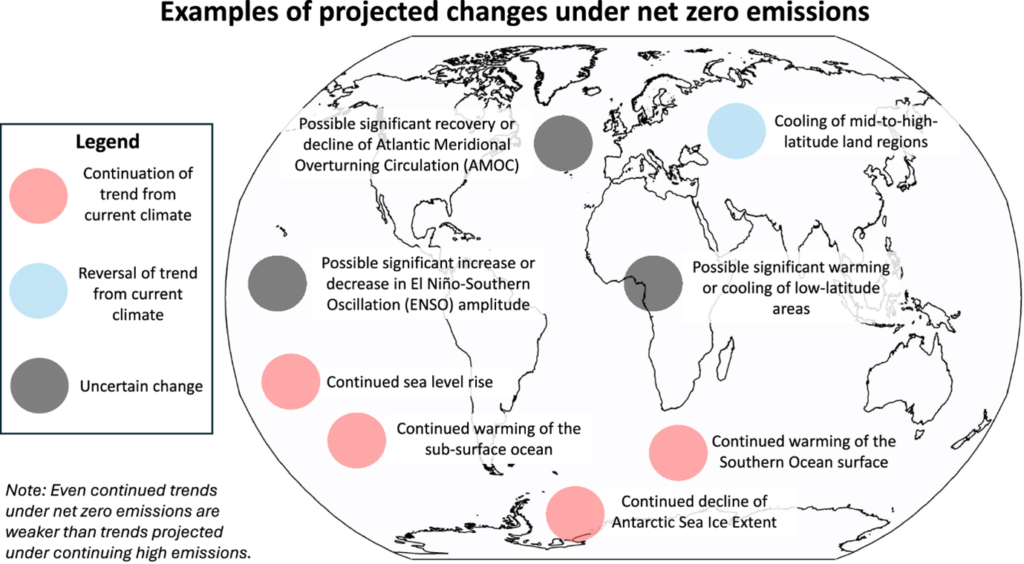
Projected significant global and regional climate changes under net zero emissions. Red circles represent projected changes that are continuations of current trends (albeit at slower rates), blue circles represent projected changes suggesting reversals of current trends, and grey circles represent uncertain changes where there is model disagreement. These are trends expected over decades to centuries under net zero pathways. From King et al. (2025)
In this project, we are already finding that even when we reach net zero emissions, substantial climate changes are projected. Antarctic sea ice extent will continue declining and sea level will continue to rise long afterwards. These changes are expected to be worse if humanity delays getting to net zero. We also know that Australia will not experience the same cooling that is likely in many Northern Hemisphere areas once net zero or negative emissions is reached. A stronger net negative emissions pathway may start to reverse some historical changes in Australia, including for land-based heatwaves which have been intensifying in our rapidly warming world and would likely weaken in a net negative emissions future.
Beyond achieving net zero, climate risks will keep evolving. Some risks may lessen, including the likelihood and intensity of drought in parts of Southern Australia, while others may continue to worsen, such as marine heatwaves and coastal inundation. Climate adaptation measures will need to continue even if we achieve our net zero goals.
What’s next?
The Hub’s research is seeking to provide more actionable and definitive information on what different net zero or net negative emissions futures would mean for Australia. This includes world-first agriculture-relevant indices and other projections. We are aiming to provide the data and information Australians need to prepare for the future we are aiming to achieve.
To read more about this research, head to this article in The Conversation >